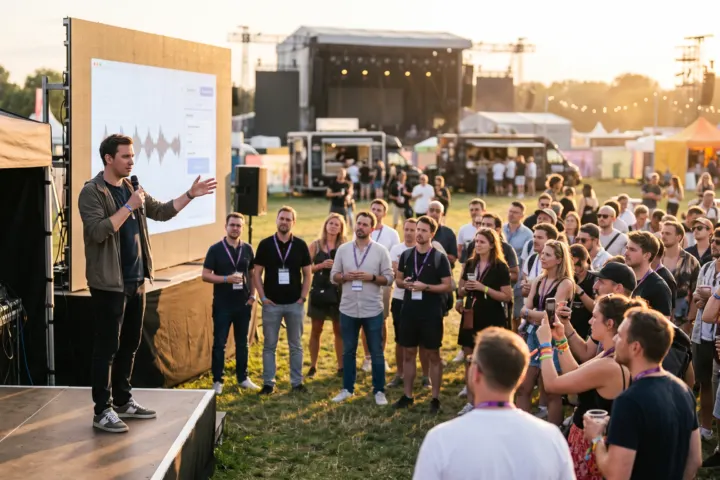
AI is taking the work around the event. The room is what’s left

Also see more events coverage: /events/
Cvent’s own events team broke its job down task by task and concluded that AI can now support about 40 percent of it. In the same launch, Cvent published a Forrester study in which 70 percent of 459 marketing and events leaders said events are becoming more important because AI makes content easy to produce. So the people who sell event software are telling their buyers that the most valuable part of an event is the part software can’t do.
Those two reports were among nine released around IMEX America, which ran at Mandalay Bay in Las Vegas from 11 to 15 October. Miguel Neves collected them in one LinkedIn post. I read all nine, plus the UFI World Map of Exhibition Venues that jwc prepared in September. This is my third piece on the same bet, after AI companies opening coffee shops in August and Informa buying Clarion last week. This time the evidence comes from the companies selling to event teams, and here’s what it supports and where it runs thin.
Buyers trust the room more as AI fills their inbox
Forrester ran its survey in June 2026 for Cvent, with directors and above who own event strategy in marketing, events and operations. Besides the 70 percent, 77 percent said audience expectations for personalization and ongoing contact are rising. The report cites Forrester’s own finding that 72 percent of business buyers trust industry peers on purchase decisions. Its reading is that buyers who’ve grown wary of AI-written digital channels now go to events to check what they’ve seen before they sign.
Freeman’s Pre-Event Trends Report gets there from the attendee side. Freeman surveyed 3,459 people in September 2026, 2,272 attendees and 1,187 exhibitors, with 77 percent of attendees based in the US. Attendees ranked in-person events as their top resource for building a personal network, at 89 percent. AI hardly shows up as a way in: 10 percent named AI search results as a way they hear about events, against 45 percent each for peers, vendors and trade associations.
The incentive travel trade says the same about its own buyers. The 2026 Incentive Travel Index from SITE and the Incentive Research Foundation surveyed 2,017 professionals in 83 countries between May and July 2026. Of those, 62.2 percent rate peer recommendations through industry associations as very effective, ahead of digital sources. When a destination makes the news for the wrong reason, 77.5 percent of buyers say relationships and experience help them look past the headlines.
AI is starting to shape the shortlist, though. In the same survey, 21 percent of attendees have already used AI to find relevant events, and 53 percent of that group say it changed their view of which events are worth attending. Freeman’s advice to organizers is four words long: « AI is your newest gatekeeper. » Asked what would make them fear missing a show, attendees named new products (45 percent) and the experts available to meet (36 percent). AI can put a show on the shortlist, and the names on the attendee list still decide whether someone books the flight.
The industry said it out loud on stage too. At the IMEX Theater, the State of the industry panel brought together Kevin Hinton (U.S. Travel Association), Kai Hattendorf (jwc), Carina Bauer (IMEX Group) and Amanda Cox (Marriott). The session’s takeaways were written by an AI, Snapsight, and the first one says people increasingly travel for connection over content. Another tells organizers to treat attendee experience as a measure of event ROI.
AI takes the tasks around the event and leaves the room to people
The most useful document in the batch is Less Mindless, More Meaningful, co-produced by Cvent and MPI. Cvent’s meetings and events team, led by Allyson Keenan, built the estimate in late 2025 from published automation research and their own judgment. Across 13 areas of event work, about 40 percent comes out as AI-supported or AI-owned, a simple average that isn’t weighted by hours.
The average hides a lopsided split. In transactional administration and workflow execution, the team rates 55 percent of the work as AI-owned. In relationship and experience management, it rates 80 percent as human-owned, 20 percent as AI-supported and none as AI-owned. Strategy and decision-making stays at 75 percent human. Cvent doesn’t soften the headline: where a role is mostly tasks, the role will change. The report also says the human share isn’t shrinking, and I agree with it.
Relationship work stays human
Share of each type of event work rated human-owned in Cvent's map. None of the relationship or strategy work is rated AI-owned. Highlighted bars are the work done with people in the room.
Amex GBT’s 2027 Global Meetings and Events Forecast reaches the same place from a different sample: 500 meeting professionals in 11 countries, surveyed by YouGov in August 2026. The top planned use of AI for 2027, at 34 percent, is giving onsite staff the insights to personalize service to attendees. Dan Beauchamp (Amex GBT Meetings & Events) sums it up: « AI can make meetings and events more human. »
EventsAir’s AI in Events report, built on its 2026 State of Events survey of more than 380 event professionals, shows where adoption has actually landed: 62.4 percent use AI for event marketing and 37.8 percent for data analysis and reporting. Attendee engagement sits at 14.5 percent, attendee personalization at 13.2 percent, and sponsorship and exhibitor work at 4.2 percent. Most of the AI in events sits in the marketing team’s inbox, a long way from the floor.
AI goes to marketing first
How event professionals use AI in event management, share of respondents. Highlighted bars are the uses that touch attendees or exhibitors, all under 15 percent.
The planners themselves are less starry-eyed. Skift Meetings and MPI surveyed 111 in-house corporate planners between July 6 and August 1. One used AI to build a transportation manifest for 3,000 attendees in a couple of hours. Several caught AI tools quoting meeting costs at almost half of what they now run. Planners also wrote that leadership assumes AI will cover the headcount it won’t fund, and Skift’s data says that isn’t happening yet.
The format is shrinking to fit the conversation
If the room is what AI can’t replace, the next question is what kind of room. For the third year running, improving the attendee experience with more memorable events is the top priority in Amex GBT’s forecast, at 42 percent. Asked how attendee expectations have changed in two years, its respondents named more personalized interactions (35 percent), richer social and curated networking (31 percent) and hands-on sessions and workshops (31 percent).
Skift’s corporate planners describe a move to smaller, more intimate formats, and the report cites Forrester’s finding that most teams now run gatherings under 200 attendees. Ryan Simonetti (Convene Hospitality Group), whose company sponsored the report, lists what planners now ask him for: executive summits, salon dinners, targeted forums and workshops.
Trade shows are moving the same way, at least on paper. ExpoPlatform’s The Meetings Engine reports that 91 percent of the exhibition organizers it surveyed plan new meeting formats in the next 12 months. Speed networking leads at 79 percent, ahead of round tables (65 percent), concierge meetings (62 percent) and hosted buyer programs (35 percent). The ebook doesn’t give its sample size, and it says itself that most of these numbers describe what organizers would do, which they haven’t done yet.
I’m not saying the big show is finished. Informa just agreed to pay £2.24 billion for more than 100 of them. The UFI World Map of Exhibition Venues, prepared by jwc and published in September 2026, counted 1,565 venues worldwide with at least 5,000 square meters of indoor exhibition space at the end of 2025, 45.2 million square meters in all. Of those, 84 offer 100,000 square meters or more. My read of these numbers is that more of the value inside the hall now sits at the meeting table, which is where curation and matchmaking earn their fee.
The proof is still the weak spot
Every report agrees the room matters, and most of the people paying for it still struggle to show what it returned. In Forrester’s sample, 77 percent struggle to demonstrate event ROI and 67 percent struggle to tie pipeline or revenue to specific programs. Only 19 percent have both their CRM and their marketing automation fully connected to their event platform, and 67 percent say their event data is too unstructured or inconsistent to use with AI. Only 25 percent treat events as a core pillar of their marketing.
Proving ROI is the hardest part of running events
Share of 459 marketing and events decision-makers rating each area challenging or very challenging. Highlighted bars are about proving what events return.
The budgets reflect it. Among Skift’s planners, 47 percent saw budgets stay flat this year and 19 percent saw cuts, while 79 percent saw costs rise by at least 5 percent. Fifteen percent don’t systematically track any ROI metric. Bernadette Mari (Duetto) describes what leadership now asks of her: « They don’t want to hear the stories. » The Incentive Travel Index finds spend per person up 7.8 percent to $5,500 this year, and 30.7 percent of buyers planning cuts next year. Amex GBT’s respondents are still optimistic, but the share who are very optimistic fell from 62 percent to 45 percent in a year.
Attendees run the same math. Among Freeman’s attendees who didn’t pick in-person events to solve a problem, 49 percent said the travel cost and time weren’t worth what they’d get.
Read the sponsor line before the headline
Nearly every report in this batch was paid for by a company that sells the answer it reaches. Forrester’s study was commissioned by Cvent and recommends a unified event platform, which Cvent sells. ExpoPlatform sells matchmaking and finds that organizers want more meeting formats. SongDivision, which runs music-led sessions for pharma teams, cites a 2017 study in Hormones and Behavior in which singing together left 71 choir members with higher oxytocin and a bigger drop in cortisol than a group that spoke together. Skift’s report is sponsored by Caesars Entertainment and Convene, both of which sell space for meetings.
That doesn’t make the data wrong. Most of these surveys are large, dated and open about their method, and the sellers behind them compete with each other. Venue groups, three software vendors, a travel manager and three associations reached the same conclusion from different samples. One commissioned study proves little on its own, and ten of them pointing the same way is worth reporting, as long as you check who paid before you quote the number.
Sell the meeting, then prove it
So if you run a show in 2027, publish the audience breakdown before the attendance figure. Build the meeting program before the stage program, and staff it with people who know the exhibitors by name. Point your AI at the admin, the way Cvent’s own team did, and put the hours it saves back on the floor. Then hand every exhibitor one number their CFO can check.
That’s what we’re building at Sesamers with mytradeshow.ai. It uses AI to help organizers design new meeting programs and attendee experiences, package them as offers that exhibitors and sponsors pay for, and turn them into new revenue lines with the results to show for it.
Will your next post-show report be able to prove what happened in the room?