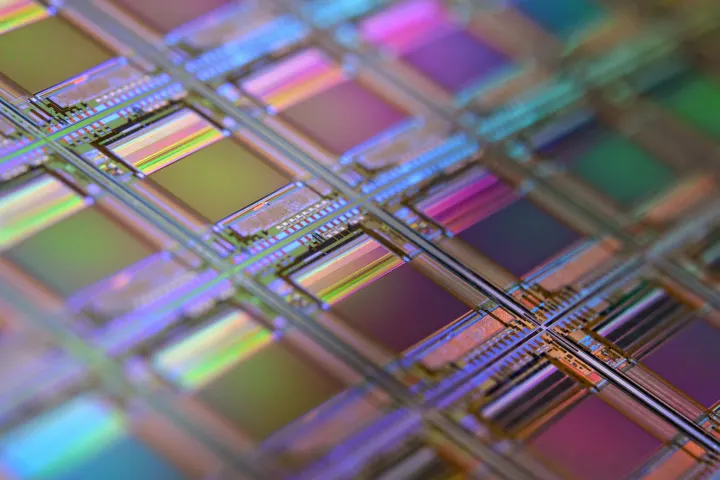
Salience Labs raises $125M Series B to wire AI clusters with light
Bullhound Capital leads an oversubscribed $125M Series B into Oxford's Salience Labs, with AMD Ventures and Intel Capital joining to scale optical switches for AI datacentres.

Also see more funding coverage: /funding/
Founded 2021 · Oxford, United Kingdom
Salience Labs, the Oxford photonics company, has raised an oversubscribed $125M Series B led by Bullhound Capital to scale optical circuit switches that connect thousands of GPUs with light instead of electrons.
Europe keeps hearing it missed the AI compute wave. And yet when the biggest names in American silicon went looking for the technology that will wire the next generation of AI datacentres together, the cheque landed in Oxford.
A $125M bet on switching light, not electrons
Salience Labs announced the round on 14 October 2026. Bullhound Capital led, with principal Callum Stewart joining the board. AMD Ventures, Intel Capital, SBI Group, Hudson River Trading and the British Business Bank came in as new investors, while existing shareholders Applied Ventures, Oxford Science Enterprises, Cambridge Innovation Capital and Silicon Catalyst Ventures all followed on.
The money goes to volume manufacturing, to the 128-port and 256-port versions of the company’s optical switch, and to a second site in Silicon Valley. “OCS will play a critical role in AI datacenter networking,” said co-founder and CEO Vaysh Kewada in the announcement, adding that the round will “accelerate our growth into high-volume production.”
The problem Salience attacks is specific. Inside today’s AI clusters, data leaves a GPU as light, is converted back into electrons at every switch, then turned into light again – a round trip that burns power and adds latency at every hop. Optical circuit switching (OCS) routes the light directly. For scale-up networks that need thousands of GPUs across multiple racks to behave like one computer, that conversion tax is becoming the bottleneck.
Ten years of Oxford and Münster physics, on one chip
Founded in 2021 by Kewada and photonics physicist Johannes Feldmann, Salience Labs builds on more than a decade of silicon photonics research at the University of Oxford and the University of Münster. Its switch is fully integrated on-chip, sits on standard CMOS, and carries proprietary optical amplification – the detail Intel Capital’s Srini Ananth singled out in the announcement.
The proof points have come fast. A 32-port version was validated by Keysight, and a 64-port all-optical switch ran live at ECOC 2026 – an industry first for silicon photonics OCS, in the company’s words. Manufacturing is being scaled with Keysight and Tower Semiconductor. The Series B follows a $30M raise in early 2025 (photonics.com, February 2025).
An $8bn switching market compounding at 30%
The segment Salience sells into is moving faster than almost anything else in infrastructure. Cignal AI puts the optical circuit switching market at more than $8bn by 2030, compounding at over 30% a year from 2026 (Cignal AI, July 2026). Zoom out one layer and Dell’Oro Group, cited in the company’s announcement, expects cumulative spending on datacentre switches for AI back-end networks to approach $1tn between 2026 and 2030, with scale-up networks accounting for more than half of it by 2030.
Against that, European photonics rounds have been running an order of magnitude smaller: Morphotonics closed a €40M Series B in September 2026 and Münster’s own Pixel Photonics raised €13.5M in April 2026, per our fundraising data. A single $125M cheque resets the scale for the sector in Europe.
AMD and Intel in the same Oxford cap table
So why are AMD and Intel, rivals in every GPU keynote, suddenly sitting side by side in an Oxford cap table? Because rack-scale networking has become the constraint on AI economics – AMD Ventures’ Patrick Rundell said as much in the announcement. The strategics are not buying a supplier; they are buying optionality on the layer their accelerators will depend on. Hudson River Trading, which lives and dies by latency, is the quiet tell in the same list.
It is also a familiar pattern for our deep tech: Europe gets funded at scale when physics is the moat. This round lands in the same week as Ubitium’s $14M seed for a universal processor, with the British Business Bank once again putting the state on the table alongside the strategics. The wrinkle worth watching is geography – the manufacturing partners, the Sunnyvale showcase at the PECC Summit on 20-21 October 2026 and the new Silicon Valley site are all pulling west. The good news is that the chips, the physics and the headquarters remain in Oxfordshire.
Watch the port counts from here: 128 and 256 are the numbers that decide whether photonic switching graduates from live demo to default architecture. Europe built the physics. Now we get to find out whether we keep the factory too – and that is a race worth watching port by port.