PORT raises €14.5M to put delivery robots on its courier hubs
London's PORT runs 3,500 courier e-bikes from 24 micro-hubs. Its €14.5M round, led by the EBRD and Balnord, pays for the AI driver and the robots meant to follow them.

Also see more funding coverage: /funding/
London-based PORT has raised €14.5M in equity and debt, led by the EBRD and Balnord, to build an AI driver and autonomous delivery vehicles on top of its 24 courier micro-hubs and about 3,500 e-bikes.
€14.5M from the EBRD and Balnord, equity and debt combined
PORT announced the round on November 10, 2026, as reported by Tech.eu. The €14.5M combines equity and debt, and the company has disclosed neither the split nor a stage label. The European Bank for Reconstruction and Development and Balnord led, with existing and new investors who were not named.
Get the Weekly brief
The week’s rounds, last calls and events, every Monday.
The round takes PORT’s total raised to €29M, after €14.5M across its pre-seed and seed rounds, according to Tech Funding News (November 10, 2026). PORT says the money will develop its AI Driver and its autonomous delivery vehicles, expand its autonomous logistics work and pay for R&D and AI hiring.
“Robotised logistics does not start with the robot; it starts with the infrastructure, operations and data,” founder and CEO Kamil Suda said in the announcement. Ervin Luga, Head of Venture Capital Investments at the EBRD, described “the missing real-world data layer” as something that “has, so far, been a prohibitive limitation” for the field, as IT Brief UK reported.
24 micro-hubs under car parks and railway arches
Founded in 2020 by Kamil Suda, PORT started by renting e-bikes to delivery couriers on subscription. It now runs about 3,500 e-bikes from 24 micro-hubs covering roughly 52,000 sq ft in London, Manchester and Birmingham, set in underground car parks, warehouses and railway arches (Tech Funding News, November 10, 2026). Over 50,000 couriers have registered, and the fleet has covered over 50 million km since 2024. The team counts 76 people, with Matas Simonavicius as CTO and Dmitri Liberman as COO.
Some of those bikes carry NVIDIA-powered cameras and lidar. When a bike docks at a hub, its footage uploads over fiber and trains the AI Driver, with faces and number plates blurred on the device. Cargo-bike trailers arrived in September 2025 and have carried over 300,000 parcels since. PORT puts the carbon saving at about 90% per delivery against a diesel van, a company figure.
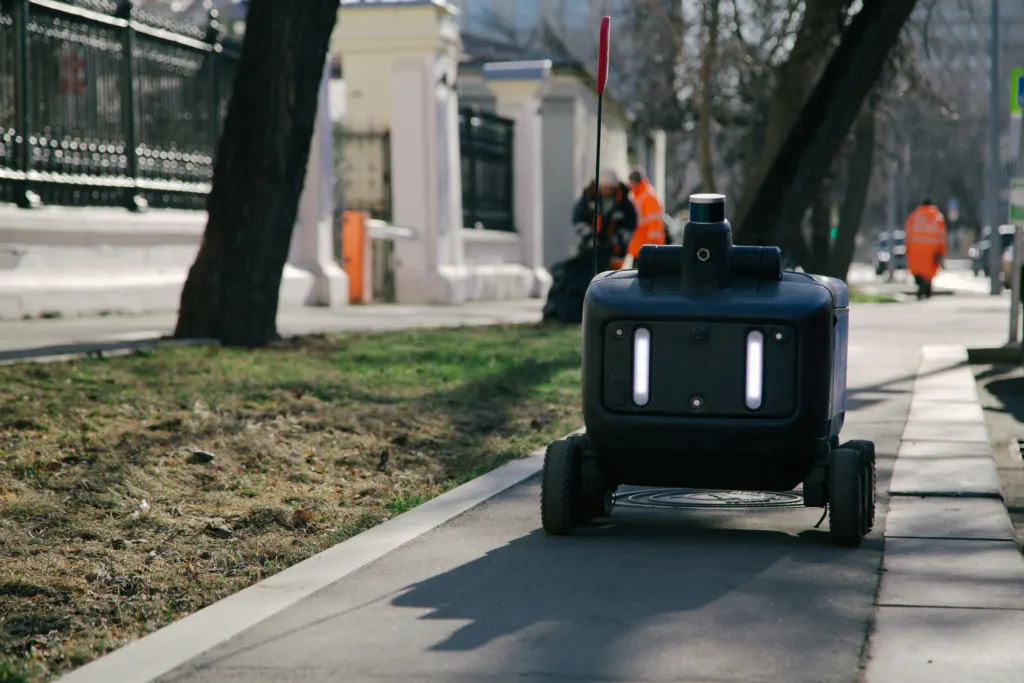
The first robot is due in the coming months and will start with parcels; PORT has not shown its design. Royal Mail is working with PORT on a new robotic delivery system, with commercial terms undisclosed. “We want to be at the forefront of this last-mile innovation,” said Jack Clarkson, Managing Director of Out-of-Home at Royal Mail (Tech Funding News). PORT has also planned a Paris micro-hub for 2026, its first site outside the UK.
Delivery robots head for USD 3.27bn by 2031
Mordor Intelligence sizes the global autonomous delivery robot market at USD 1.33bn in 2026 and USD 3.27bn in 2031, a 19.74% CAGR over 2026-2031 (report page updated September 11, 2026). It gives no separate figure for Europe. At that rate the market grows about 2.5 times in five years, and PORT enters it with 24 hubs already operating as start and end points for its robots.
The robot makers PORT will meet already have capital. Tech Funding News names Whizz, which raised a $12M Series A led by Leta Capital, and Coco Robotics, at $80M. Closer to home, our European fundraising data logs a €35.6M Series B in 2025 for HIVED, another London last-mile carrier, and earlier this month Conlio raised €6.4M to automate freight billing, led by Piton Capital.
A development bank and a Baltic fund back the hubs-first model
I have sat through many delivery robot pitches that open on the robot. PORT’s story opens on 50,000 registered couriers and a hub in a London railway arch.
I find the investor pairing the most telling part of this round. Balnord is an early-stage fund for frontier and dual-use technology in the Baltic Sea region, backed by the EIF and PFR Ventures, with first tickets of €0.5-3M and follow-ons up to €12M (Tech.eu, November 7, 2025). The EBRD’s venture team put its name to a quote about data, and Suda’s own line about infrastructure matches it. Both quotes describe a company whose asset is the network it has already built.
The good news is that we have plenty of the raw material for this model. Lyon, Milan and Warsaw all have underground car parks and courier fleets. How many city halls will let robots leave those car parks at street level? We are called a single market, yet each new city still brings its own rules for what can roll on its streets.
Imagine if the camera-equipped share of those 50 million km becomes the training set that gets a parcel robot through a Manchester junction. Remember: the EBRD quote names the data layer as the limitation, and PORT already records it every time a bike docks.
Three things to watch before the first robot ships
The equity and debt split, which PORT has not published. The robot’s design and its first parcel route. The Paris micro-hub and the city rules it will open under. Each will tell us whether the hubs-first model travels beyond the UK. Let’s watch the first parcel robot leave a PORT hub, and let’s build the next 24 hubs in Lyon, Milan and Warsaw!