Creative tech in Europe runs on grants. San Sebastián’s finalists prove it

Also see more events coverage: /events/
Ten startups pitched at the San Sebastián Film Festival on 24 September. I went through every one of them afterward and couldn’t find a single disclosed venture round. The biggest cheque on the day was the festival’s own: €30,000 for the best Spanish project.
We were in the room at Prisma, Tabakalera, for the final of the Zinemaldia Startup Challenge, invited by our friends at Zinkup, a local marketing agency. Zinkup also works on BIND, the Basque open innovation program that Sesamers supports by scouting the French market. Here’s who competed, which company took two of the three awards, and what the cohort says about how creative tech gets financed in Europe.
Get the Weekly brief
The week’s rounds, last calls and events, every Monday.
It was great to see this program run inside a flagship festival like San Sebastián. As far as I know, Cannes and the Berlinale have similar initiatives. A lot more could be done to bring tech into the creative sector, which is why we keep going to see what’s cooking.
Two juries picked the same Finnish cinematographer
The festival runs the Challenge with TECNALIA, ALÍA and Vicomtech, inside its Spanish Screenings: Financing & Tech program. The 2026 edition was the eighth. It drew 68 applications, and the festival shortlisted five Spanish and five European startups, according to its finalists announcement in August.
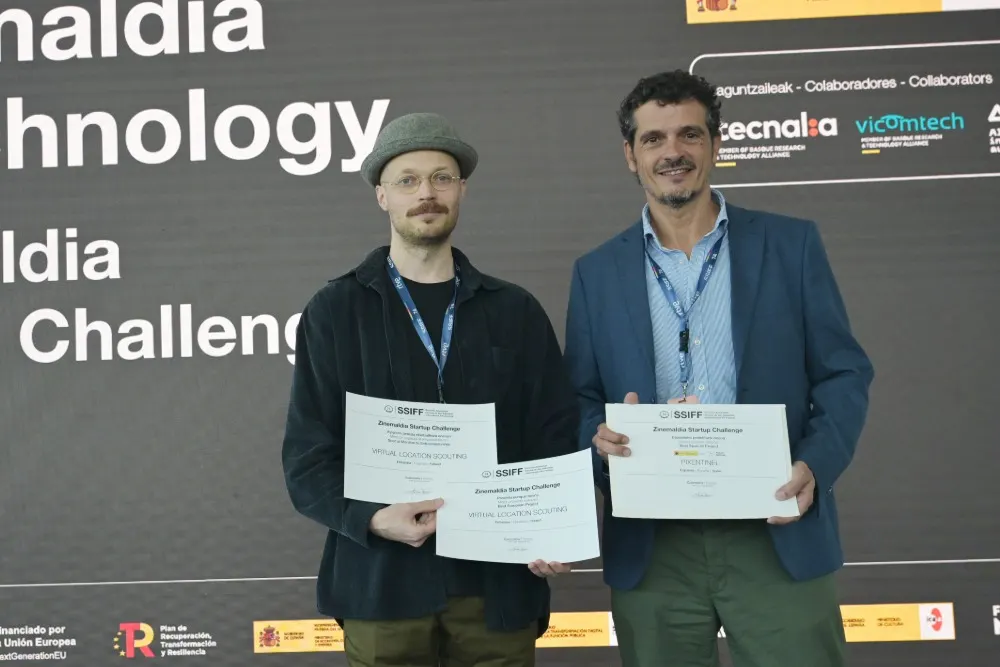
Three awards went to two companies. Pixentinel, presented by founder Luis Zabala, won Best Spanish Project and €30,000. It watches live streams, finds the root cause when a signal fails and acts on it. Spain’s Ministry for Digital Transformation funded the increase that took the Spanish prize to €30,000 this year, according to the festival’s winners announcement.
Gaussian Scout, entered as Virtual Location Scouting, won Best European Project and €10,000. Then it won the Entrepreneurship Mention and another €3,000. The festival hands the mention to a third jury, separate from the two track juries, which can pick a finalist from either competition. It picked the same company.
The founder is Antti Ahokoivu, a Finnish cinematographer who builds the tool through his Helsinki company, Laskos Virtuals. It turns Gaussian splats and 3D scans into a copy of a real location that a whole crew can walk through in a browser before the shoot. It’s still a prototype, with a subscription launch targeted for autumn 2027, according to Variety’s report from the final.
The prize was the biggest cheque in the room
I’m not arguing that grants are a bad sign. Public money is how a lot of European deep tech reaches a first product, and a film festival backing technology with a ministry prize is good news for founders. Across these ten companies, though, it’s the only money on record.
- Volum Technologies is a spin-off of the i2CAT research center in Barcelona, set up in July 2025. The research behind it drew more than €3.7 million in EU and Catalan grants, according to the Generalitat de Catalunya. i2CAT holds a stake. No priced round has been announced.
- Into Reality was self-financed, went through Telefónica’s Wayra program in 2025 and was raising €500,000 in February 2026, ViaEmpresa reported.
- SuperScout received a MyWorld grant from UK Research and Innovation in 2024.
- TheGreenShot reached €7.2 million in 2024 revenue on loans and grants: €500,000 from finance&invest.brussels in 2023 and a €1.5 million credit line from Triodos Bank in 2025. Forbes Belgique reported in February 2026 that it had never raised from outside shareholders.
- Pixentinel, Dymensium, HaMo, Graphrs and THELMA have disclosed no outside funding.
For Pixentinel, the €30,000 is the only money on record.
Creative tech in Europe runs on public money.
Most finalists are still proving the product
The festival grades every finalist on how far its product has come. Three pitched a validated prototype, five sell an early version to first customers, and two sell to their main market.
Finalists by development stage
Both winners came from the two earlier stages: Gaussian Scout (prototype) and Pixentinel (early version).
Finalists by development stage. Bar chart. Functional prototype, validated 3; Early version sold to first customers 5; Mature, selling to its main market 2.
Both winners came from the two earlier stages. The two most mature companies left without a prize. TheGreenShot has more than 400 clients and has bought companies in France and the United States. I read the result as juries backing where a product could go, and a €10,000 prize moves a prototype further than it moves a company that size.
Two of five European finalists built tools for location scouts
Sort the ten by where they sit in a production and the planning stage comes out on top.
Finalists by production stage
Where each finalist's product sits in a film or TV production.
Finalists by production stage. Bar chart. Planning and location scouting 3; Capture and animation 3; Distribution and viewing 2; Rights and sustainability 2.
SuperScout, from London, and Gaussian Scout, from Helsinki, both manage film locations. One is a searchable database of every place a team has visited. The other is a walkable 3D copy of the place itself. Graphrs, from Berlin, handles the crew and the schedule for the same shoot days.
Artificial intelligence runs through the rest. Six of the ten list it in their festival category. The other four list augmented or virtual reality.
The ten finalists
Spanish competition:
- Pixentinel, Spain. Operational intelligence for live streaming. Best Spanish Project.
- Dymensium, Valencia. Volumetric capture with 4D Gaussian splatting.
- HaMo Real-Time Animation System, Spain. Real-time animation and motion capture for interactive characters, from Paramotion Films.
- Into Reality, Barcelona. An interactive player mixing 2D and VR360 streams.
- Volum Technologies, Barcelona. Real-time volumetric capture and holographic telepresence.
European competition:
- Gaussian Scout, Finland. Shared 3D location scouting in the browser. Best European Project and Entrepreneurship Mention.
- Graphrs, Germany. An operating system for video production, with crews in more than 20 European cities.
- SuperScout, United Kingdom. A private location database for film offices and location managers.
- TheGreenShot, Belgium. A sustainability data platform for film and TV production.
- THELMA, Finland. Protection for public figures’ image, voice and likeness online.
Apply with a prototype and a production problem
The festival publishes each call on its Zinemaldia Startup Challenge page. Here’s what this year’s results tell the next applicants.
- Watch for the call in spring. The 2026 call ran from 24 April to 5 June.
- Enter the right track. Spanish startups compete for the €30,000 prize, European ones for €10,000, and the €3,000 mention can go to either.
- Bring a prototype. Gaussian Scout won twice without a paying customer.
- Prepare to pitch live. All ten finalists pitched in person at Prisma, Tabakalera, during the festival.