AI events in Europe: the conferences that matter
Research conferences, industry expos and festival AI stages do different jobs - how to pick European AI events by job, density and verified dates.

Also see more events coverage: /events/
European AI events split into three species – research conferences, industry deployment events, and the AI tracks bolted onto generalist festivals – and picking the right one depends entirely on whether you are hiring researchers, selling to enterprises, or raising money.
“AI event” has become a nearly useless label. Every conference in Europe now claims one, every festival has an AI stage, and the calendar is thick with summits of wildly varying substance. This guide sorts the landscape into types, matches each type to the job it actually does, and gives you a filter for evaluating any AI event before paying – plus the verified dates we could confirm for the season ahead.
Europe’s AI moment, briefly
The context that explains the crowded calendar: AI was Europe’s top-funded sector in the first half of 2026, with €5.9bn raised, per Tech.eu (July 2026). Money attracts events; events attract sponsors; sponsors attract more events. The result is genuine signal – Europe has real research depth and a fast-growing applied-AI industry – wrapped in a great deal of conference-industry opportunism. The sorting matters more here than in any other sector.
The three species of AI event
Research conferences: papers and recruiting
The academic tier – the big ML conferences and their European workshops and satellite editions – runs on peer-reviewed papers, poster sessions and the hallway track. Nobody is buying software here. What these events are unmatched for is talent: if you are hiring research scientists or want your team absorbing the frontier, this is the room. Labs and well-funded startups treat the recruiting function as the real agenda; the papers are public within days, but the conversations with the people who wrote them are not. If you are not hiring researchers or publishing, you are tourism.
Industry events: buyers and deployment
The commercial tier is built around enterprise adoption – case studies, vendor floors, CIOs and heads of data comparing notes on what actually shipped. The conversations are about procurement, integration and governance, not architectures. Verified examples with dates, all checked with the organisers’ own sites this August:
- AI & Big Data Expo Europe – 19-20 October 2026, RAI Amsterdam. A classic expo format: vendor floor plus conference tracks, aimed at enterprise data and AI teams.
- World AI Cannes Festival (WAICF) – 10-11 February 2027, Palais des Festivals, Cannes; the organiser projects around 7,500 attendees. A European AI gathering mixing corporate, vendor and research-adjacent programming.
- The AI Summit London – 9-10 June 2027, Tobacco Dock, during London Tech Week; the organiser reports 5,000+ attendees for the 2026 edition. Squarely a commercial event: enterprise buyers and applied-AI vendors.
Beyond these, the calendar is full of national AI summits and sector-specific applied events whose next editions we could not verify at time of writing – treat any date you see for them as expected and TBC until the organiser confirms. Attendee figures above are organiser-reported; apply the usual discount.
AI tracks inside generalist festivals
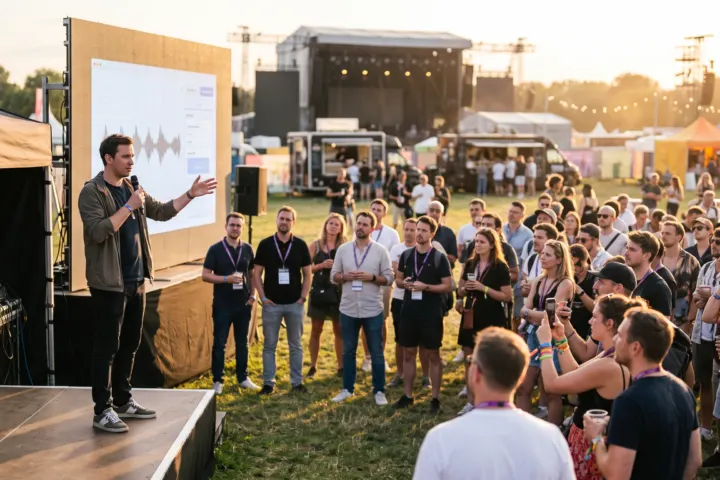
Every European flagship now runs one. Web Summit (71,386 attendees and 1,857 investors in November 2025), Slush (13,000 attendees, 3,300 investors, November 2025) and VivaTech (180,000 visitors, 3,600+ investors, June 2025) all programme AI heavily – because their audiences demand it, and because AI startups are now a large share of their exhibitor base. The honest framing: these are not AI events. They are startup-and-investor events where AI is the dominant theme. That makes them the right room for an AI startup doing the capital job – the investors are there in volume – and a mediocre room for selling AI to enterprises or hiring researchers, because the AI-specific density is diluted across everything else.
Match the event type to the job
| Your job | Right species | Why |
|---|---|---|
| Hiring researchers | Research conferences | The talent is physically present and professionally obliged to talk about their work |
| Selling to enterprises | Industry events | Buyers attend with deployment budgets and procurement questions |
| Raising capital | Festival AI tracks | Investor density is what festivals do; the AI label just organises the schedule |
| Market intel / positioning | Industry events + one research conference a year | Deployment reality on one side, the frontier on the other |
| Community / profile | Smaller applied-AI gatherings | Recurring, dense rooms compound; stages do not |
Hiring researchers is not the same job as selling to enterprises, and no single event does both well. Teams that treat “AI event” as one budget line end up at the wrong species for their actual goal – the most common version being an applied-AI startup spending its budget on festival stages when its buyers are at the unglamorous expo in Amsterdam.
The density question, applied to AI
The general Sesamers principle – density of your people beats total headcount – bites hardest in AI, because the label inflates headcounts everywhere. A 300-person applied-AI event where half the room runs ML in production can outperform the AI stage of a 70,000-person festival for almost every job except fundraising: your cost per meaningful conversation collapses when the filtering has been done by the event itself. Big festivals filter for interest in tech generally; a good specialist event filters for exactly the conversation you want to have. Before defaulting to the famous option, price both against the same metric: what will a meaningful conversation cost at each?
How to evaluate an AI event before paying
- Speaker-to-attendee reality. Read the agenda: are the speakers practitioners with deployment scars, or sponsors’ VPs delivering product keynotes? A speaker list dominated by the sponsor roster tells you who the event serves.
- Vendor ratio. Ask the organiser – or estimate from the exhibitor list – what share of attendees are selling versus buying. AI events skew notoriously vendor-heavy; a floor of vendors selling to each other is a fate worth paying to avoid.
- The alumni test. Find three past attendees whose role matches yours and ask what they got. For AI events specifically, ask whether the technical content was current – the field moves fast enough that a stale programme is visible within months.
- Specificity of the programme. “The future of AI” panels are filler; talks named after concrete problems (evaluation, inference cost, regulated-industry deployment) signal a programme built by people who work in the field.
FAQ
What are the biggest AI events in Europe?
By raw scale, the AI tracks at generalist festivals – VivaTech (180,000 visitors, June 2025), Web Summit (71,386, November 2025), Slush (13,000, November 2025). Among dedicated AI events, WAICF in Cannes (10-11 February 2027) and The AI Summit London (9-10 June 2027) are among the larger confirmed ones. Biggest and most useful are different questions.
Should an AI startup go to research conferences or industry events?
Depends on the job that quarter: research conferences to hire scientists and track the frontier; industry events to meet enterprise buyers; festival AI tracks to meet investors. Budget by job, not by label – the three species barely overlap in audience.
Are big festival AI stages worth it for AI companies?
For fundraising, often – the investor density is real. For sales or hiring, usually not: the AI-specific density is diluted, and a small applied-AI event will produce cheaper meaningful conversations. Price both options per conversation before choosing.
How do I check if an AI event is credible?
Four checks: practitioner speakers rather than sponsor keynotes, a sane buyer-to-vendor ratio, past attendees who can name concrete outcomes, and a programme specific enough to date itself. Then confirm dates with the organiser – AI event calendars shift, and anything unconfirmed should be treated as TBC.
Keep going
The selection method behind all of this – jobs, density, cost per conversation, the alumni test – is our pillar on startup events. If the capital job points you at the festivals, Web Summit vs Slush compares the two biggest investor rooms, and the VivaTech guide covers June in Paris; for the city itself, see startup events in Paris. And when you are ready to shortlist, our events worth your badge hub is the running verdict.